
The first European on Sakhalin Island
By Rene Attema, Frisian historian of the Nethrlands for the book Calamity Islands by Oleg Klimov

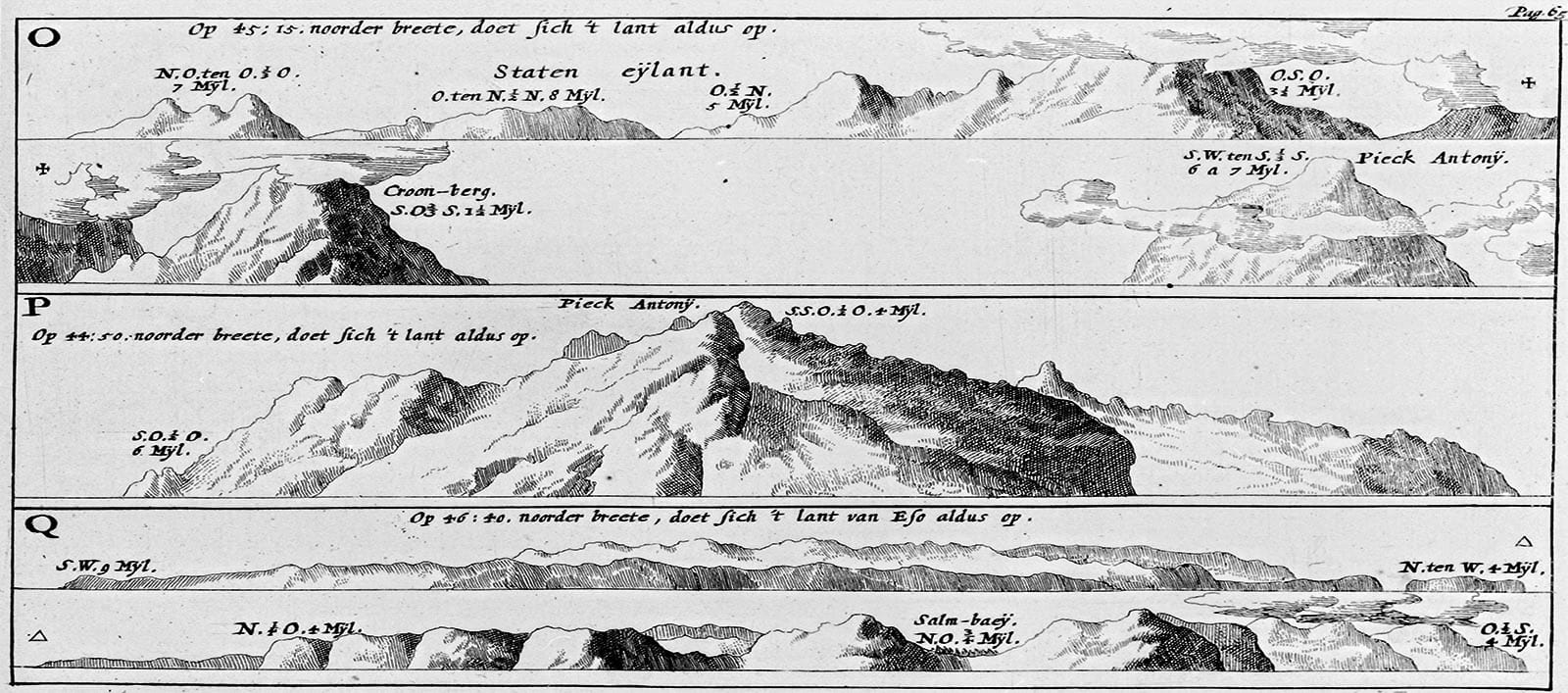
It is July 1643. The United East India Company (VOC) fluyt Castricum, a cargo vessel with three masts and a distinctive broad belly, cautiously approaches the south-eastern shore of Sakhalin. Skipper Marten Gerritsz Fries launches a pirogue to find a suitable anchorage. After some search- ing, the crew of the small boat signalled that the seabed was 10 fathoms deep and good enough to drop anchor. While the men rowed back towards the fluyt, they realised that they were being chased by three rowing boats. The men of the Castricum hurried back to the ship. It did not take long for the three pursuers to reach the VOC ship. The initial fear turned out to be unnecessary.
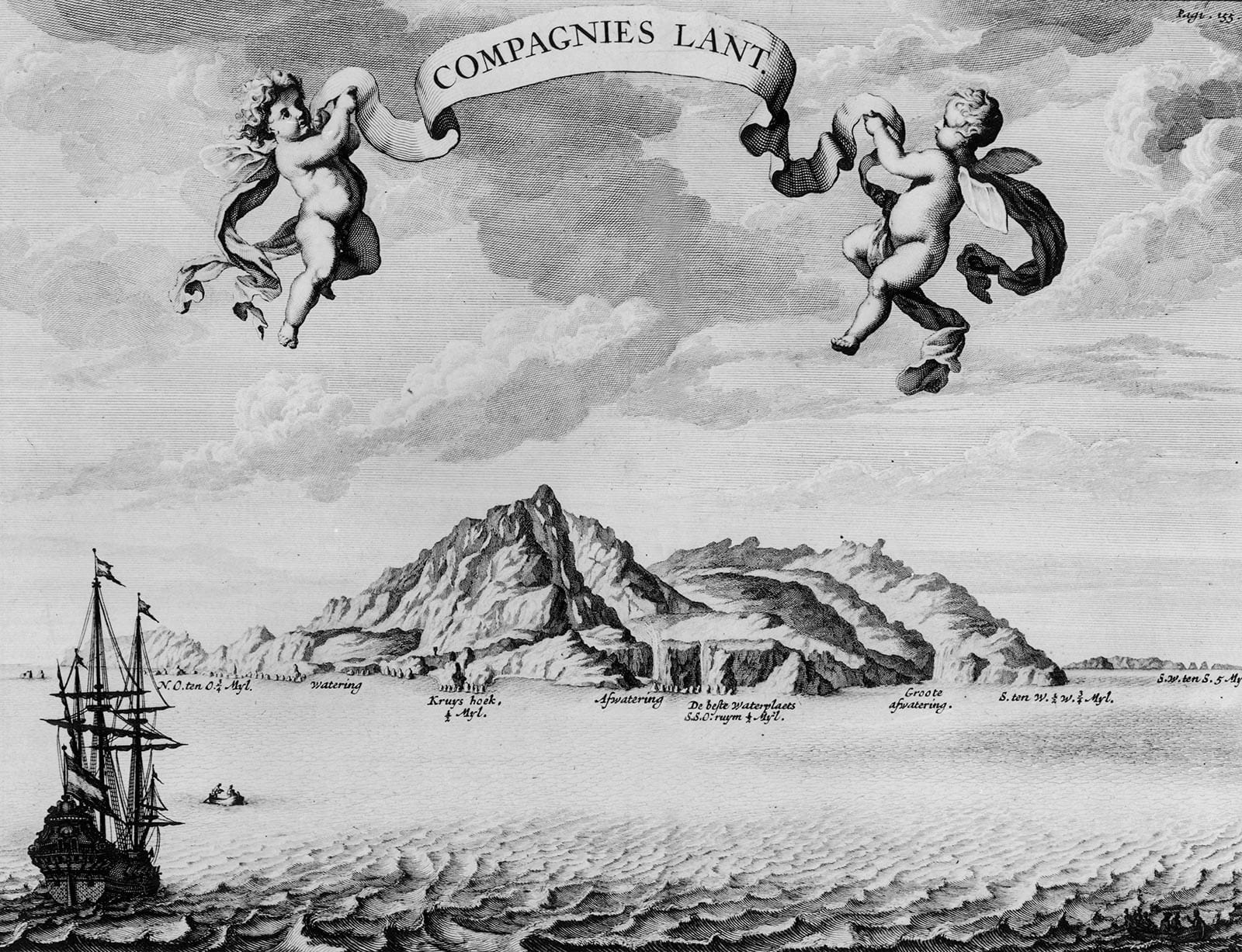
The visitors did have any ulterior motive. This was the first meeting between the Ainu people, the original inhabitants of Sakhalin, and Dutch explorers. The atmosphere remained friendly when the Dutch went ashore next day and called their anchorage Aniva Bay. Why they chose the name Aniva is not entirely clear. The pronunciation, taken from the Ainu language, probably resembles Aniva. Anyhow, Marten Fries wrote history. He was the first European to set foot on Sakhalin. But not for long. Fries accidentally discovered the island while his primary aim was to find a route north for the VOC.
Who was Marten Gerritsz Fries?
Marten Gerritsz Fries is fairly well-known around the Pacific, but unknown to people in the Neth- erlands. There are no statues and no stories about him in history books. In that respect, his life story fits seamlessly with the forgotten history of Sakhalin.
What we know about him so far is mainly based on indirect sources. Though his name is written in different ways, he called himself Marten Gerritsz Fries, as can be seen in the signature on the contract with instructions for his VOC expedition in 1642. Fries was probably born on 28 February 1589 in Harlingen, one of the famous Frisian Eleven cities. But even his year of birth is controversial. An estimate by one of his companions in 1643 suggests he could have been born ten years later.
He lived in Harlingen before the VOC sent him to Java. According to the van Delden Collection in the Dutch National Archives in the Hague, in July 1622 Fries arrived aboard the ship Het Wapen van Hoorn in Batavia, the VOC’s headquarters in Asia. There he started as a surveyor, cartographer and pilot. In 1639, he married Josina de Vreeze, a woman from Ghent in Flanders.
Together they were to have three children: daughter Josijntje and sons Gerrit and Johannes. As second-in-command under VOC explorer Abel Tasman (1603-1659), he travelled in 1640 to Japan with four ships to deliver merchandise and gifts. A year later, Fries, in the meantime promoted to skipper, was involved in the siege of Malacca. Together with the Sultan of Johor, the VOC defeated the Portuguese there, after which the VOC assumed power. A year later, Fries took part in the successful conquest of Fort Quelangh, after which the last Spaniards were chased from Formosa (now Taiwan). Because the VOC was delighted with Fries, he was promoted to captain-commander in 1642 and put in charge of the vital expedition to Japanese waters to explore a Northeast Passage to Europe. Why did the roaring Dutch lion spread its claws to the north?
The reason for the expedition
The Dutch East India Company (1602-1800) was a trading company, but not an ordinary one. In the 17th century, the VOC was not only the largest trading company in the world, but also had its own military and its own currency. The VOC was powerful because it had acquired a monop- oly on the overseas trade between Holland and Asia. In the homeland, the VOC was organised in local chambers coordinated by the Heren XVII. Six cities had chambers: Amsterdam, Mid- delburg, Rotterdam, Delft, Hoorn and Enkhuizen. The province of Friesland did not have one, so the VOC chamber in Hoorn appointed Marten Fries.
The Dutch had already been active in Asia from 1596 on. At a given moment one point they were triggered by rumours about gold and silver on two unknown islands, as reported by a Por- tuguese ship’s crew driven ashore earlier in the 1580s. Fuelled by this report, a gold rush started after 1611. Dutch espionage brought the story to the Netherlands. After the VOC trading post on Deshima, an artificial island located in the port of Nagasaki, confirmed the islands’ possible presence in 1635, the VOC decided to join the race also in this region. Encouraged by the board of the Heren XVII, expeditions were organised from Batavia.
The first expedition to the north took place in 1639 and was led by Matthijs Quast. This ex- pedition was a total failure. Quast was forced to abandon the voyage and sailed to Formosa. On arrival, almost half of the crew apparently died of scurvy due to the lack of fresh food. And so Marten Fries tried again in 1643. Governor-General Anthonie van Diemen (1593-1645), responsible for many VOC voyages of discovery and expansion, no longer believed the stories about islands with gold and silver. Therefore, despite the Heren XVII’s explicit orders, he set different priorities for the second expedition of Fries, according to the voyage instructions and the ship’s journal kept by first mate Cornelis Jansz Coen, which were recovered in the nineteenth century. Van Diemen wanted the unexplored areas to the north and east of Japan to be mapped in detail. For example, he wanted to know how far north Japan extended and whether Hokkaido was an island or the mainland coast of Siberia.
The northern part of China and the east coast of Siberia also had to be mapped. Apart from new trade opportunities, Van Diemen wanted to find a possible passage ‘around the North’. This route to Europe would be shorter than the usual southern route via South Africa. Attempts to navigate the Northeast Passage from the Netherlands had so far failed. Depending on the weather conditions, Van Diemen also allowed Fries to cross to the unknown west coast of Amer- ica. According to the data known at the time, it was not far from Japan. In the meantime, Fries also had to look out for the mythical gold and silver islands.
On 4 April 1643, two ships left the island of Ternate in what is now Indonesia: the fluyt Castricum and the smaller yacht Breskens, both named after towns in the Dutch Republic. In mid-May, disas- ter struck when the two ships lost each other in a severe storm. Fries decided to continue on his own. As they sailed past Japan, they regularly received visits from Japanese fishermen who occa- sionally reacted strangely: shy, aloof and cautious. Something was going on, but what? That puz-zled the Dutch skipper. In mid-June, Fries moored the Castricum near Eso, now Hokkaido. In the meantime, the Breskens sailed into a Japanese bay. That caused a riot with the coastal residents.
Contacts with foreign ships had been prohibited by the Shogun in Japan, except on Deshima, where only a limited number of Dutch people were allowed. Japan was very afraid of Christianity and its drive to convert. As a result, part of the crew was taken prisoner. In hindsight, this also explained the Japanese fishermen’s behaviour when the Castricum sailed past.
Shortly afterwards, Fries visited several Kuril islands. He contacted the residents, exchanged goods, gave them cheap gifts and spirits, heard them out about the presence of gold and silver, handed out the Dutch tricolour and erected wooden poles with the text ‘VOC anno 1643’. His intention was obviously to claim the areas for the VOC if desired. The Dutch made quite an im- pression on the people of the Kuril Islands.
In Japanese documents, the Dutch were described as giants. In mid-July 1643, the Castricum fi- nally anchored in Aniva Bay off Sakhalin. Fries thought he was still on Hokkaido, because dense fog meant he missed the strait between Hokkaido and Sakhalin. The Dutch were impressed by the Ainu. For example, when those ‘shaggy white dogs’ hunted for salmon and delivered their catch to their fellow residents’ huts. Or when they didn’t just throw a bone on the hut floor, as would be usual in Holland, but put it in a special bowl. Fries and his crew also exchanged gifts for a live black bear. Unfortunately, we do not know what happened to the bear afterwards.
The further north Fries sailed, the worse the weather became. Persistent headwinds, fog, storm and cold made Fries abandon the attempt to find a Northeast Passage. He turned about and headed back to the southern waters.
The Dutch had been instructed to behave well when meeting the local population. They stuck to that rule, but things changed when Fries lost his patience. In mid-August, the Castricum sailed into a bay on Hokkaido’s southern coast. They dropped anchor near a village and re-established contact with the residents. Slowly the Dutch started to realise that the residents may well have been aware of their intentions, namely to find gold and silver. Some residents alluded to the presence of precious metals. However, when the Dutch wanted to find out more, they were sent on a wild goose chase. It seemed the residents wanted to stay on friendly terms with the Dutch, but also to lead them astray. When a crew member innocently patted a young girl on the head, it caused quite a stir. The Dutch donated gifts to the village chief to calm things down. But Fries remained suspicious. He interpreted the behaviour of the village chief as cunning and avari- cious. He was also fed up with being misled all the time.
So next day, he ordered his crew, armed and in uniform, to march to the village. What was go- ing on? Did Fries want to impress the locals as instructed? Or was he planning further action? We now know the Dutch did not shy away from violence.
Anyhow, peace was restored. The villagers and the Dutch said a harmonious goodbye on 1 Sep- tember. The Castricum returned home. As they sailed south of Japan on 9 November, the crewsaw a ship in the distance. It turned out to be the Breskens with the remnants of the crew that had not been captured. Many of the ship’s crew were ill, so Fries decided they should sail to Formo- sa. They arrived there on 18 November 1643.
Although Fries had not succeeded in finding gold and silver or a suitable Northeast Passage, the VOC considered the expedition successful. New areas and shipping routes could be discovered and mapped out in detail. The crew of the Castricum was given a bonus. Fries himself was rewarded by being appointed Examiner of the Ship Journals of the Skippers and Mates on 8 February 1644.
What about the crew members of the Breskens who were taken hostage in Japan? For a while, they faced the death penalty. But they were not executed, because proponents and opponents of terminating trade with the Dutch started quarrelling about the best sanctions. Deshima was the only window on Europe for the Japanese. Trade with the VOC was also profitable. The Japanese rulers did not want to lose that income. So a solution was sought without losing face. So the chief of the Dutch trading post on Deshima and the powerful Shogun became involved in the negotiations and succeed. On 8 December 1643, the captured crew was released. Ten months later they finally returned to Batavia. Japan, in turn, had second thoughts. Believing that the VOC was not appreciative enough of the crew’s release, Japan demanded an official token of gratitude from a senior Dutch envoy. Only in 1949 were the Dutch willing, albeit reluctantly, to officially acknowledge this with lots of flags and ceremony in Japan. The VOC did not want to lose its position on Japan either. Because the Netherlands, unlike Portugal and Spain, kept religion out of trade and did not actively promote it, it remained welcome as the only European country. That unique relationship lasted until 1853.
Aftermath
After the 1643 expedition, the VOC did not return to Sakhalin and the Kuril Islands. Why not? Van Diemen died in 1645 and so the great animator of the voyages of discovery had gone. The need for a shorter Northeast Passage diminished when a resupply camp for VOC ships was established in 1652 at the Cape of Good Hope. The existing spice trade and silk trade also yielded sufficient wealth. What would a trading post on Sakhalin and the Kuril Islands add to this? The end of the Eighty Years’ War against Spain in 1648 also plays a role. In the peace treaty, the European parties reached agreement on overseas territories.These clauses ensured that the VOC could keep its Asian conquests. Meanwhile, belief in the myth of gold and silver had faded. But what if precious metals had been found on Sakhalin?
That would undoubtedly have led to a land grab. Sakhalin could then have been named Noord- land, as Australia was called Zuidland or New Holland after its discovery. Or perhaps even New Friesland with a capital named New Harlingen. Then Dutch might now be the primary language, and Anton Chekhov’s book on his to Sakhalin would never have been written.
The story of Marten Gerritsz Fries was not over yet. In 1644-45, he was still needed at sea. So he scanned the waters in search of the Spanish ‘silver ships’ en route from Mexico to Europe. It was his duty to intercept them. On 17 February 1646, he was promoted to commander of a substantial fleet. Partly because the first peace negotiations with Spain were about to start, the VOC wanted to make another attempt to take over the Philippines from the Spaniards and get more leverage at the conference table. In the Philippines’ waters, a series of five naval battles with the Spanish Armada took place that year. Fries tried to block the Bay of Manila. But he was unable to defeat the Spaniards, and the fleet withdrew.
Fries again went to war against the Spaniards: this time with a fleet of about twelve ships. And then things did go wrong. Two stories circulate about the death of Fries. According to the first version, the Dutch tried to land in the Philippines in June 1647, but were driven back. They did manage to destroy the stone fortress of Porta Vaga, but when the fleet was exposed to heavy ar- tillery fire from the coast near Cavite Harbour, Fries’ flagship was hit and sank. Fries was among the many crew members who drowned. Another version suggests that Fries died in December 1647 when, on his way to the Philippines, a disease broke out on the ships, killing an estimated 600 sailors. Fries was among the victims and was given a seaman’s grave. Judging from the VOC correspondence between June and December 1647 and the daily registers from the Cas- tles Zeelandia and Batavia, this is the correct version.
Unlike many of his famous contemporaries, Fries has been forgotten in the Netherlands. He is sometimes mentioned in publications as the discoverer of Sakhalin. A strait between two islands of the Kuril Islands bears his name, as do two streets in the Frisian capital Leeuwarden and in the naval city of Den Helder. But in his birthplace Harlingen the city museum, unlike the regional museum on Sakhalin, has hardly any interest in him.
René Attema, Frisian historian, Harlingen, winter 2020