Thou Shalt Not Kill
Praying for Russia? Ask for Sanity
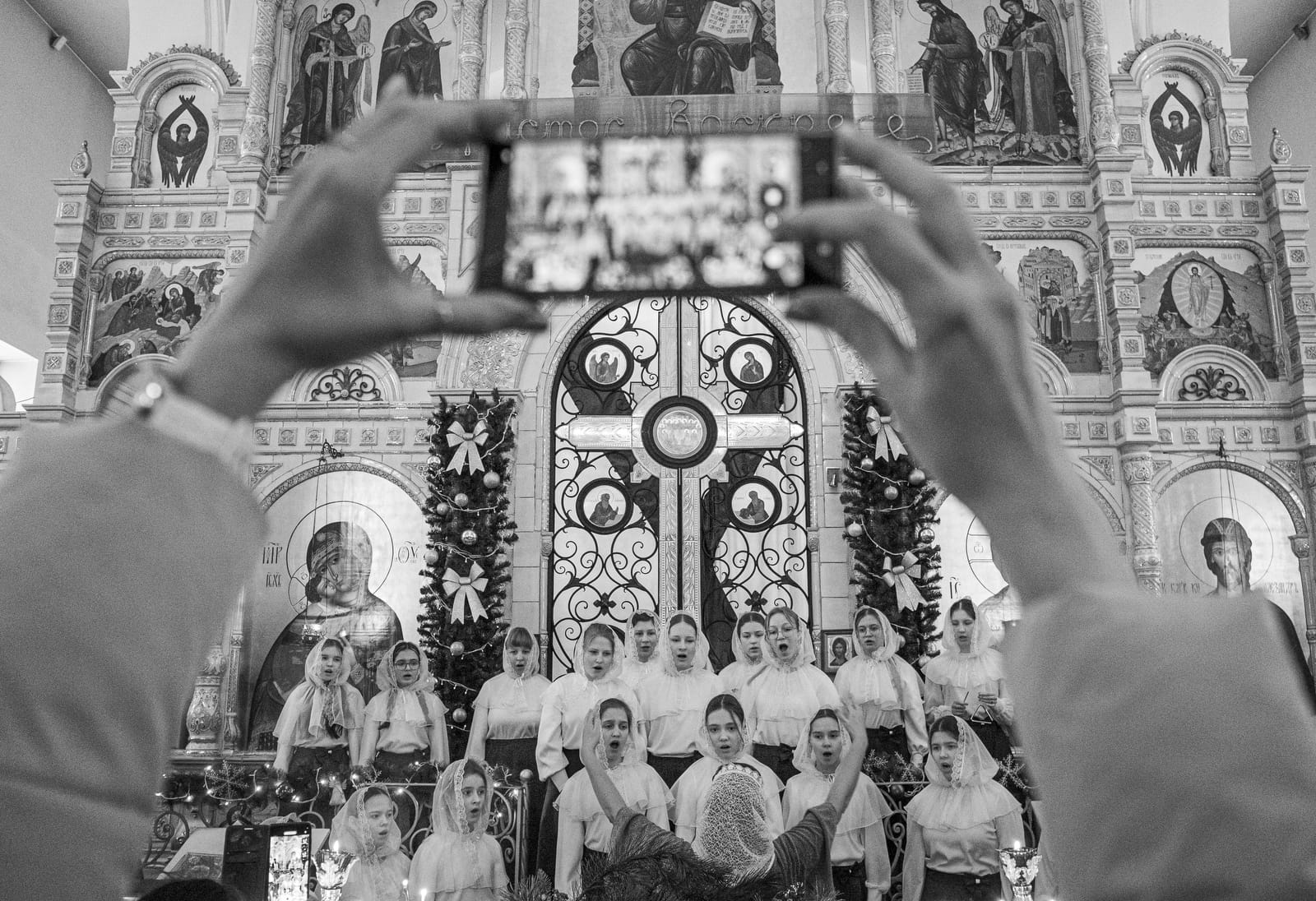
In Baltiysk — Russia’s westernmost city and a key base of its Baltic Fleet — Orthodox Christmas is celebrated on January 7, not December 25. The reason: the Russian Orthodox Church still follows the Julian calendar, unlike most of the Orthodox world, which has long aligned with the modern Gregorian one. But in Russia, the “special path” endures — even when it leads backward.
Orthodox Christmas at the Church of St. Alexander Nevsky, Baltiysk. January 7, 2026. Photo by Oleg Klimov
Baltiysk is not just a port city. With nearly 30,000 residents, it’s also one of the most militarized places in the country. Around 60–70% of the local population is directly or indirectly connected to the military. It’s a city where camouflage outnumbers Christmas lights — and where tradition is shaped as much by generals as by priests.
This year, Christmas came with guns and incense, icons and uniforms — a reminder of how war and faith have become entangled in modern Russia.
Patriarch Kirill, head of the Russian Orthodox Church, recently justified the killing in Ukraine with theological arguments. “When evil threatens the lives of women, children, and the elderly, inaction is unacceptable,” he declared. “Nonresistance becomes complicity in murder.” (RIA Novosti, 2025) The commandment “Thou shalt not kill” has rarely sounded so conditional.
"A person whose opinion differs from the unified state position is a traitor to the Motherland" said Patriarch Kirill today.
But not all believers follow this logic. Theologian Andrei Kuraev offered a blunt rebuttal: “Praying for Russia? — Ask for sanity.” (Pravmir.ru)
In today’s Russia, even Christmas has become a battlefield — between conscience and obedience, dogma and doubt, silence and truth.
Делитесь информацией - делайте мир свободным:
The best way to support Freelancer
Oleg Klimov, doc. photographer